
SEO Title: Company-as-a-Service: A Flexible Model for Global Startup Expansion
Meta Description: Discover how Company-as-a-Service helps startups and SMEs access corporate administration, incorporation support, and international business services.
URL Slug: company-as-a-service-global-startup-expansion
Company-as-a-Service: A Flexible Approach to Global Startup Expansion
International expansion has traditionally required businesses to establish local infrastructure, recruit employees, build administrative teams, and manage complex regulatory procedures.
For startups and small and medium-sized enterprises (SMEs), these requirements can create substantial financial and operational challenges.
However, the development of digital business services and specialized corporate support providers has introduced more flexible ways for companies to manage selected administrative responsibilities.
One emerging concept is Company-as-a-Service (CaaS), a service-based approach that allows businesses to access corporate and administrative support through external providers.
Rather than building every operational function internally, companies can obtain selected services according to their specific needs.
1. Understanding the Company-as-a-Service Model
Company-as-a-Service refers to a business service model in which external providers offer selected corporate and administrative solutions to entrepreneurs and organizations.
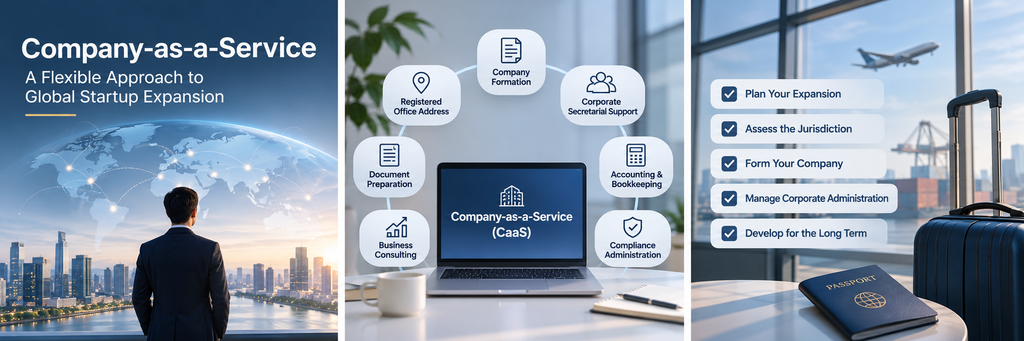
Depending on the provider, jurisdiction, and service agreement, these solutions may include:
- Company formation assistance.
- Registered office and business address services.
- Corporate secretarial support.
- Document preparation and coordination.
- Accounting and bookkeeping services.
- Compliance administration.
- Business consulting and operational support.
The objective is to simplify certain administrative processes and provide businesses with access to specialized services without requiring them to establish every function internally.
It is important to understand that Company-as-a-Service does not replace the legal responsibilities of a company or its directors.
The business remains responsible for complying with applicable laws and fulfilling its obligations.
2. Why Startups Need Flexible Business Solutions
Startups often operate with limited financial resources and small teams.
During the early stages of development, founders usually prioritize product development, customer acquisition, market research, and revenue generation.
Managing corporate documentation, registration procedures, and ongoing administrative responsibilities can consume valuable time.
Flexible corporate service models can help address these challenges by providing access to external expertise.
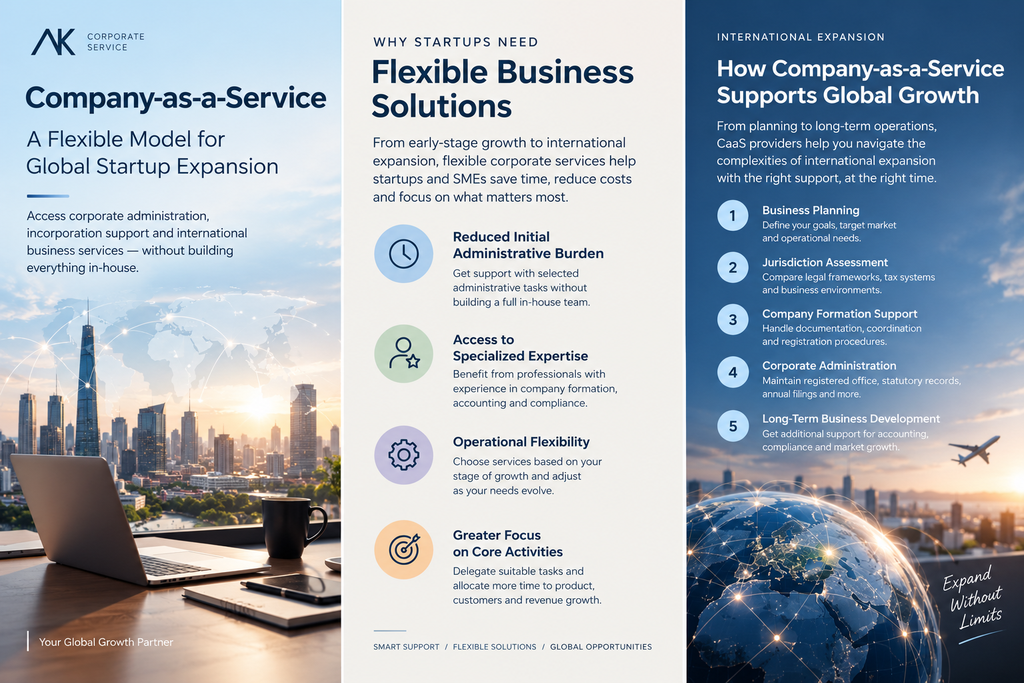
Reduced Initial Administrative Burden
Businesses can obtain support with selected administrative activities without immediately building a complete internal corporate administration team.
Access to Specialized Expertise
Professional service providers may offer experience in company formation, documentation, accounting coordination, and jurisdiction-specific requirements.
Operational Flexibility
Companies can select services according to their development stage and adjust their requirements as operations grow.
Greater Focus on Core Activities
By delegating suitable administrative tasks, founders can allocate more time and resources to commercial development.
These advantages depend on the provider’s capabilities, service scope, and the company’s actual requirements.
3. How Company-as-a-Service Supports International Expansion
Expanding into another country involves several important decisions.
Companies must evaluate the target market, select an appropriate legal structure, understand regulatory requirements, and establish suitable operational arrangements.
Company-as-a-Service providers may support selected stages of this process.
Stage 1: Business Planning
Before establishing an overseas entity, businesses should identify their commercial objectives, target customers, expected costs, and operational requirements.
Stage 2: Jurisdiction Assessment
Different countries offer different legal frameworks, incorporation procedures, tax systems, and business environments.
Companies should compare these factors before selecting a jurisdiction.
Stage 3: Company Formation Support
Depending on the service agreement, a corporate service provider may assist with documentation, application coordination, and registration procedures.
Stage 4: Corporate Administration
After incorporation, companies may require ongoing assistance with registered office arrangements, statutory records, annual filings, and other administrative responsibilities.
Stage 5: Long-Term Business Development
As the company grows, additional support may be required for accounting coordination, compliance administration, operational planning, and market development.
4. Common Challenges in International Startup Expansion
Although international expansion offers significant opportunities, businesses should not underestimate its complexity.
Several common challenges require careful consideration.
Regulatory Differences
Each jurisdiction has its own incorporation rules, reporting obligations, licensing requirements, and corporate governance standards.
Banking Accessibility
Opening a corporate bank account is subject to financial institution policies, customer due diligence, business activities, and eligibility criteria.
Company incorporation alone does not guarantee banking approval.
Taxation and Reporting
Businesses must understand applicable tax obligations, reporting deadlines, and potential cross-border tax considerations.
Operational Substance
Some jurisdictions impose requirements relating to actual business activities, management, personnel, or economic substance.
Choosing the Right Service Provider
Businesses should evaluate service scope, professional qualifications, transparency, communication, and fee structures before entering into an agreement.
5. Selecting the Right Corporate Service Partner
A reliable corporate service partner can help businesses navigate administrative procedures and understand relevant corporate requirements.
Before choosing a provider, companies should consider several factors.
First, review the provider’s experience and knowledge of the relevant jurisdiction.
Second, request a clear breakdown of services, fees, timelines, and ongoing responsibilities.
Third, understand which activities are performed directly by the provider and which require external professional assistance.
Finally, ensure that communication channels and documentation procedures are clearly established.
Businesses should avoid providers making unrealistic promises about incorporation speed, guaranteed bank accounts, or guaranteed tax outcomes.
6. The Future of Flexible Corporate Services
As international business becomes increasingly digital, companies are looking for more accessible and scalable ways to manage administrative operations.
Cloud-based documentation, digital communication, integrated accounting tools, and online corporate administration platforms are changing how businesses interact with professional service providers.
These developments may create additional opportunities for SMEs that want to operate internationally while maintaining flexible internal structures.
However, technology should complement professional judgment and regulatory compliance rather than replace them.
Conclusion
Company-as-a-Service provides a flexible approach to accessing selected corporate and administrative support.
For startups and SMEs, this model can help reduce certain administrative burdens, improve operational flexibility, and provide access to specialized expertise during international expansion.
Successful implementation requires careful jurisdiction selection, transparent service agreements, and a clear understanding of ongoing legal and regulatory responsibilities.
With appropriate planning and professional support, businesses can build a more structured pathway toward international growth.
Planning to establish or expand your business internationally? Contact AK Corporate Service to explore corporate support solutions aligned with your business objectives.